My work is deeply rooted on my parents-rendered home education: eat when others are eating, work when others are working, visit only those that visit you, and the like. Although the education was simple, it makes me seek unique perspectives, grounding important decisions on a moral foundation. This must be why I found myself wanting to home-educate two beautiful kids I raise, which wanting intensified until I discovered Waldorf education, where parents continue being main parts of child raising — I talk below about how my Waldorf education has a profound impact on the global expansion of my business.
RaHa began as I saw, first-hand, the difficulty some villages had in finding clean water.
While on my first assignment as an employee of a consulting engineering firm, Otieno Odongo & Partners –– supervising and managing civil works on a road project –– I saw that quarries left behind collected contaminated rainwater, which was the best water for villagers. I brought my engineering skills to bear on solving the pressing need for clean water close to home. Rainwater Harvesting (RaHa) seemed the ideal solution. I researched the best methods for RaHa in low-income settlements.
I wanted a system that:
- requires no electricity;
- needs little maintenance;
- would be kept up by village members without need for skilled labor;
- is of greatest value for building cost;
- requires low to no cost to run;
- is long lasting; and,
- is hygienic.
For water storage, I chose zincalume steel tanks, each with a life-span of more than 60 years. I got filters and other water cleaning components for both rooftop and non-rooftop rainwater harvesting.
I chose solar toilets as means to reducing rainwater contamination.
I also chose reusable sanitary towels for reducing toilet clogging.
Starting out, I helped recondition tanks for a new lease on life for Oiti village in Kajiado Kenya. The tank was not used for several years because it could not contain water. I used my own funds to make the tank useable. This made A Ms Grace Mueni nominate for RaHa the water scarce community of Kavililo in Kitui, Kenya. Water was so scarce there, that when she drove from Nairobi to the community, she would fill her car with cans of water to take to the village. Some villagers had to walk 12 hours for a single round trip to collect water. Again, I used personal money to drill a well or bore hole in Kavililo. I also bought a hand pump for the borehole.
As community service, a part of Waldorf education, Nairobi Waldorf students transported the hand pump to Kavililo.

But I could not continue to fund all the projects my heart wanted to do, so I created RaHa, RaHa Solutions & Raha Charitable Trust. My understanding of the need for community participation helped me set up a unique way to involve the community, advertisers, and media. Through creative publicity and shared work, RaHa builds a sense of joint ownership and responsibility.
I Want Free Services of Medical Doctors /Specialists (FSMD) For Those Without Quality Medical Cover
As a parent at Nairobi Waldorf School (Kenya) and Earthschooling (USA), I learned that, since we (human) are threefold beings, solutions to our problems/challenges are to be Threefold Social Organisms (TSO) in which we unfold as complete human organisms.
Concurrently, I want FSMD for those without quality medical cover as they mostly fall sick due to water scarcity and or toilet-less-ness.
Services of medical doctors/specialists (SMD) are extremely important for any given individual. They are also important for everyone around the individual — they’re important for his/her family, they’re important for his/her colleagues, they’re important for his/her employe/r/e/rs/es, and they’re really important for society at large as his/her good health is what allows him/her to make positive contributions to the society.
Therefore, society must give free services of medical doctors/specialists (FSMD) to (Tom, say) who doesn’t seek SMD when he should, mainly because he has no quality medical cover — cost of people not seeking SMD when they should is at least $500bn.
But this (giving FSMD to Tom) must start with giving FSMD to (Alex, say) who typically seeks SMD when he shouldn’t, mainly because he has quality medical cover — cost of people seeking SMD when they shouldn’t is $50bn and unnecessary SMD is FSMD after all, as no medical cover encourages policyholders to seek SMD when policyholders shouldn’t. Overall value of FSMD should be better than value of the unnecessary SMD, for example, time for giving Alex FSMD should be a lot shorter than time for giving him equivalent unnecessary SMD, so that the saved time is spent on giving FSMD to Alex, Tom and 8 others.
In other words, as we (humans) are threefold, FSMD are to be a TSO in which both Tom and Alex can naturally unfold as complete human organisms i.e.,:
• Tom does not plan for SMD and Alex seeks unnecessary SMD. Since this is a CULTURE/freedom (that Tom and Alex develop from self-directed SMD-related actions rooted in inner awareness and moral responsibility), Tom should not be forced to start planning for SMD neither should Alex be forced to stop seeking unnecessary SMD. Patient Centricity is to be at FSMD’s heart, Tom’s and Alex’s experience of FSMD is to be smooth, coherent, and transparent in order for Tom and Alex to be the ones to decide to start seeking FSMD and, once they start, to develop self-directed FSMD-related actions rooted in inner awareness and moral responsibility.
• Since good health can suddenly pivot from being something taken for granted to something that is the most important and most urgent, FSMD are to be quickly accessible to Tom and Alex, not only in order for us, as a society, to reduce cost of not seeking SMD when we should and cost of seeking SMD when we shouldn’t, but also for LEGAL/equality purposes. The biggest global challenge in healthcare today is inadequacy of SMD, which (inadequacy) leads to inequitable allocation of SMD with profound negative impacts for individual health and society at large. See, because hospitals on one part of the globe are understaffed, that part of the globe offers higher salaries to attract healthcare professionals from elsewhere to fill in the gaps. This creates shortages elsewhere, leading to those elsewhere to in turn offer higher salaries to fill in their gaps. Not only does this lead to an unsustainable spiral of increasing costs, along with job insecurity for many healthcare professionals (as the offers typically come in short term contracts); a situation where only 1% of the world’s doctors / specialists work in low-and-middle-income countries has also ensued.
• In ECONOMIC/fraternity terms, FSMD to be better than unnecessary SMD in value so that Alex seeks FSMD so that Tom and 8 others get FSMD.
Existing & Emerging Ideas aren’t Helping:
• Asking ‘Google’ for FSMD is not only time consuming, ‘Google-ing’ for FSMD exposes society to the real danger associated with misinformation.
• Insurers are stuck in way before ‘age of Google’, where the way to make/save more money is to offer increasingly inferior SMD at increasingly higher costs — the Industrial Revolution fundamentally changed the situation where, for most of human history, better quality meant higher costs, and lower costs meant worse quality; and for the first time in human history, we were able to produce goods and services that were both better and cheaper.
• Unfortunately, even today’s so-called technology innovations also seem to have missed the history class — companies are building and deploying technologies that don’t fulfil that basic promise of delivering better for less. Virtual healthcare and telemedicine, a trend that has gained momentum, and continues to thrive, merely substitute in-person visits with video calls — replacing a 30-minute face-to-face SMD, with a 30-minute video SMD does not save much money; during the COVID-19 pandemic, in particular, healthcare costs went up and it was creating more stress on the health system.
Therefore, I started accelerateUHC, a project that adds FSMD to my original work (of giving RaHa systems, reusable sanitary towels and toilets)
To accelerateUHC, we make doctors/specialists to start focusing only on what they do the best (or what they prefer doing!), which is interacting with patients. Should a doctor/specialist be running a health facility, we reduce the administrative burden on the doctor/specialist to make them ready for the next patient — we focus on optimising doctors’ ability to interact and on distributing the ability more efficiently so that this limited resource can be used equitably to maximise the positive impact for everyone in the society.
Concurrently, the following cycle happens:
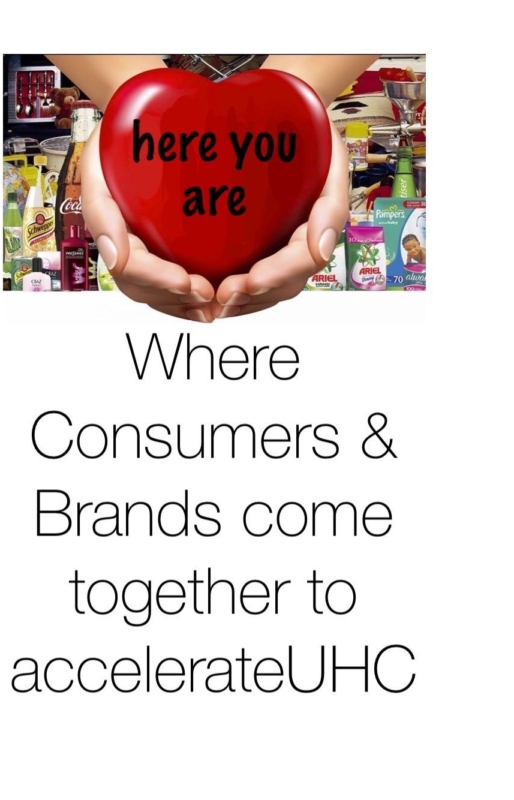
- we invite patients (our beneficiaries) to ask us for FSMD, which they (our beneficiaries) do not pay for (in cash), all they do is enable us see their approximate locations by pointing at any products, services, receipts, business cards, adverts etc that they buy or get from owners of the products, services, receipts, business cards, adverts etc;
- owners of the products, services, receipts, business cards, adverts etc sponsor FSMD; and,
- we pay the doctors/specialist for the services they give to our beneficiaries.
This way,:
- We enable owners of products, services, receipts, business cards, adverts etc to sell or give more of products, services, receipts, business cards, adverts etc;
- We avail SMD to everyone as everyone can very easily see or find products, services, receipts, business cards, adverts etc; and therefore,
- We enable doctors/specialist to be engaged more and to generate more income compared to engagement/income they would get from their typical work setting and this is one of the reasons we’re able to deploy our services across the United States and in other over 40 countries globally, with such efficiency and ease; and,
- The insured that seek SMD when they shouldn’t start to enable doctors and specialist in general to serve everyone else — recall that cost of people going to the doctor when they shouldn’t is $50bn. From insurers’ perspective, the insured reduce (by 81%) ‘doctor visits’ by seeking FSMD. This mutually beneficial outcome leads to reduced loss ratios for insurers and a more favourable return on investment for all stakeholders. Rather than limiting services and withholding access from policyholders, health insurers can enhance their offerings and provide more efficient care to their customers, all while reducing costs, by urging their respective members to, as a fraternity gesture, seek FSMD.
accelerateUHC improves care delivery, supports early intervention, and reduces pressure on overburdened facilities — we improve patients’ experiences and health outcomes, regardless of literacy, location, or access to smartphones.