VISION
DuGut™ App creates an economic link between Consumers, Brands and Social Good Deeds.
“Consumer spending is the most powerful force in World Change. According to Forbes, …U.S. alone … gave $400 billion to charities last year, but … also spent $130 trillion dollars buying stuff …
If even a fraction of that spending can fight climate change, reduce poverty and inequality, the impact is enormous!•
“Imagine an App where a brand’s success can be measured by its good deeds.” Wouldn’t a brand want to do more good deeds? … And if consumers can see how much good is being created by what they buy and use on a regular base, wouldn’t they embrace such an App?
That’s why we created DuGut™ App, so we can weave “Giving” to Causes and Social Ventures into everybody’s daily lives. By using “consumerism” as a force: we can take real action on today’s most pressing issues and make our world a better place.
Our history is defined by the youthful push to make America more just, more compassionate, more equal under the law. This generation-of Parkland, of Dreamers, of Black Lives Matter-embraces that duty. If they make their elders uncomfortable, that’s how it should be. Our kids now show us what we’ve told them … about, even if we haven’t always-believed it ourselves: that our future isn’t written for us, but by us.
Barack Obama – the 44th President of the United States
While everyone can become a DuGut™ Actionist, DuGut™ is specially designed to meet the needs of the new generations’ social consciousness because Gen Y and Z want to change the world. This generation is a new breed of open-minded, socially-conscious and world-centric individuals who question the status quo and the way that our society works. They realize that some traditional norms simply don’t fit anymore into the hyper-informed, creative, and technological age, and that things need to change – quickly. DuGut™ provides an Activist Marketplace for these generations so they can drive action. We call them Actionists! (Source: Nielsen, Forbes, BusinessMirror)
“They realize that some traditional norms simply don’t fit into the hyper-informed, creative, and technological age anymore, and that things need to change – quickly .”
High-school students Nia Arrington (center), Christian Carter (left), and Cheyenne Springette (right) lead the march down Liberty Avenue in downtown Pittsburgh during a walk-out in solidarity with Parkland students on February 21, 2018. (Stephanie Strasburg/ Pittsburgh Post-Gazette via AP)
Inset –– Emma Gonzalez, a senior at Marjory Stoneman Douglas High School, speaks at a rally for gun control at the Broward County Federal Courthouse, in Fort Lauderdale, Florida.
CHARITY IS BROKEN
When it comes to helping the poor, unfortunate, and those negatively affected by our changing world, everybody always thinks about non-profit organizations and traditional fundraising. The truth is, that traditional methods simply can’t fix the ills of the world, when the total annual donations from America, the biggest contributor in magnitude and per capita to worldwide causes, only accounts for 2% of the GDP. Furthermore, this amount has remained unchanged since the 7Os. (Source: charitynavigator.org)
For those who say … Don’t fix what’s not broken, we want to let them know that it’s just not enough!
An Approach Developed With Insight
DuGut™‘s novel approach was developed through research and insight. By combining recognized Marketing Technologies, cutting edge Ai, and the efficiency and transparency of the Blockchain (Gen 2); we will increase and stimulate giving to causes that can take real action to help solve the most pressing issues of our society today! When giving is woven into the fabric of our daily lives and integrated into our everyday consumer lifestyles – like going food shopping or buying clothing – then giving becomes a truly sustainable and growing activity.
But of course there is a broader vision to make it even more effective. The next generation DuGut™ Marketplace, Gen 2 Platform, will be delivered as a Decentralized Application on the Blockchain (DApp) to make full use of the efficiencies provided by open and transparent hyper-ledger and to better engage our users and brands and connect them to all causes.
THE BIGGER PICTURE
We are currently working on and testing an early development of the Gen 2 Platform – “DuGut™ Social Fuel Platform··- and have created the website and the whitepaper for the 4Good Token (Blockchain) that will be used on the DuGut™ Social Fuel Platform.
DuGut™ Marketplace is an online platform that appeals to Brand Activism and CSR and creates a direct economic link between Brands, Consumers, and Social Good Deeds.
Like every other marketplace, we connect buyers and sellers, but what sets us apart is that we use Ai and Blockchain to stimulate giving to Grassroots Causes that drive real action!
DuGut™ is available as a mobile web platform, and soon as an Android App, and iOsApp.
We reward consumers for getting their friends involved in social causes by matching them to the brands that support these causes.
Through Artificial Intelligence -Ai – we can identify similar networks with similar intensities that may also support a social cause and provide recommendations to increase a social networks reach.
Our Social Accelerator is currently functional and in use.
Harness the forces of capitalism to work toward a positive outcome for humanity.
Blockchain technology (4Good Tokens) allows our digital marketing tools, featured in the DuGut™ market place, to reward consumers in an open and transparent manner.
Consumers can see the direct economic impact of their personal usage of a brand on the fabric of society.
The rewards that are cash right now will be replaced by the token.
DuGut™ MARKETPLACE
DuGut™ App doesn’t compete with, nor does it takes away business from the currently available large marketplaces, we just stimulate consumers and brands to donate to SDGs of their choice. We let our users choose where they want to buy from. Once a purchased product shipment arrives, consumers can scan the product or label of
their purchase, and the DuGut™ System goes in motion.
In the near future we will create our own API.
Ai
We reward consumers for getting their friends involved in social causes by matching them to the brands that support these causes.
Through Artificial Intelligence – Ai – we can identify similar networks with similar intensities that may also support a social cause and provide recommendations to increase a social networks’ reach.
Our Social Accelerator is currently functional and in use.
BLOCKCHAIN & CSR
Trust is, and has always been, the foundation upon which we make our decisions when transacting with one another. It is how we decide whether the parties that we are interacting with are dependable and likely to fulfill their side of any deal. The social world by nature doesn’t trust businesses that make profit. They believe that CSR is just another marketing technique.
However, the nature of trust, or ––more precisely –– how it is determined, has not always been what it is today.
As the nature of how we determine value evolved, so did the range of people with which we could transact.
In the past we only transacted with the people in our immediate vicinity, like a town or city. With the dawn of the internet the marketplace grew to include everyone in the world who has internet access.
It is in this way that blockchain gives businesses a platform to act with genuine integrity towards their community and customers.
Blockchain has the potential to add transparency to more than just the financial aspect of business. For example, one of blockchain’s foremost user cases are within supply chain management. The technology can allow for the immutable tracking of anything across the supply chain. This means that consumers can know exactly what their food contains, whether it is organic and fair trade, whether their goods are genuine or produced with respect to workers’ rights.
This is not only beneficial to the consumer –– in that they can be absolutely sure about where products came from and what they contain –– but also to the company producing the products. Such transparency helps to maintain the integrity of a company by reducing scandals in production, such as, a reliance on sweatshops to produce cheap clothing.
Blockchain could slash the cost of transactions and reshape the economy
Businesses are built on contracts, from incorporation to buying-supplier relationships to employee relations.
“Smart contracts” may be the most transformative blockchain application at the moment. These automate payments and transfer of currency or other assets as negotiated conditions are met. For example, a smart contract might send a payment to a supplier as soon as a shipment is delivered. A firm could signal via blockchain, that a particular good has been received –– or the product could have GPS functionality, which would automatically update that, in turn, would trigger a payment.
Organisations can also tackle specific problems in transactions across boundaries with localised applications. Companies are already using blockchain to track items through complex supply chains, for instance.
Developing substitute applications requires careful planning, since existing solutions may be difficult to dislodge. To get traction, substitutes must deliver functionality as good as that of a traditional solution and must be easy for the ecosystem to absorb and adopt.
First Data’s foray into blockchain-based gift cards is a good example of a well-considered substitute. Retailers and Brands that offer them to consumers can dramatically lower costs per transaction and enhance security by using blockchain to track the flow of currency within accounts –– without relying on external payment processors. These new gift cards even allow transfers of balances and transaction capability between merchants via the common ledger.
4GoodToken will be as secure and cost effective as it will be transparent for both customers and brands.
Guiding Your Approach to Blockchain Investment
For most, the easiest place to start is single-use applications, which minimise risk because they are not new and involve little coordination with third parties.
One strategy is add Tokens as a payment mechanism (4GoodToken). The infrastructure and market for crypto coins are already well developed, and adopting the virtual currency will force a variety of functions, including IT, finance, accounting, sales, and marketing, to build blockchain capabilities.
By maintaining its transactions strictly between Consumers and brands, 4GoodToken bypasses a lot of risks. We are not aiming to be a bank, nor will we venture into Government space… We just use consumerism to help causes and social organisations to drive real action.
The transparency and efficiency of Blockchain Technology are best and fastest way to achieve our goals on Global Scale
Source: Harvard Business Review
G4Good Tokens Blockchain System
4GoodToken intends to use Blockchain Technology to align business intentions and consumer motives to do more good
- Encourage more brands to contribute more to social responsibility
- Create a strong incentive for large groups of people to work together towards a positive social outcome.
- Allow almost everyone to participate.
- Archive powerful network effects for participation.
- Provide easy measurement ability and accuracy
How 4GoodTokens Work
DuGut™ will issue ERC20 compliant 4GoodTokens through the Ethereum stat contract system. ERC20 standard is basically a specific set of functions which developers must use in their tokens to make them ERC20 compliant. While this is not an enforced rule, most DAPP developers are encourages to follow the standards to ensure that their tokens can undergo interaction with various wallets, exchanges and smart contract without any issue.
DuGut™ is a publicly registered body in Wyoming with legal responsibilities and is subject to public audits by certified audit companies. This will ensure the transparency of operations and the secure custody of the funds.
- 4GoodTokens can be exchanges through intermediaries and can be used by advertisers on the DuGut™App to secure ad-space and reward their users with 4Good crypto-tokens as well. 4GT will be usage tokens where an advertiser who wants to use our services will need to buy with 4GoodTokens (4GT)
- Similar to a loyalty card, consumers will register to get money back (T4G) on purchases. During the registration process, consumers will create an Ether wallet, if they don’t already have one, and identify the SDGs (charity/cause) to which they want to donate
- Consumers receive credits for 4GoodTokens by buying or selling products or being engaged with Social Brands
Market Opportunity
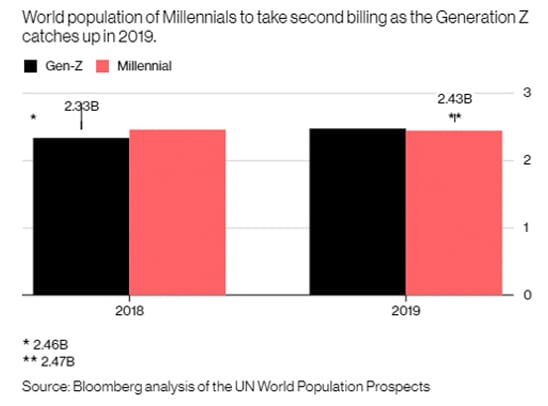
Although we target both Millennials (Gen Y) and Centennial (Gen Z), the latter is becoming more active than the former, as the “Activist Generation”.
Despite their young age, the leading edge of Generation Z is already demonstrating this social consciousness – for example, the Afghan teen, Malala Yousafzai, at age 18, became the youngest person ever to win the Nobel Peace Prize. Moreover, Gen Z boasts plenty of less celebrated activists –– in a recent study by cultural forecasting firm, Sparks and Honey, found that 26% of 16 – 19 years olds already volunteer on regular basis (Source: Businessinsider, theatlantic.com)
Gen Z seems to learn from their older siblings, the Millenials, who are defying their reputation for entitlement by turning out to be remarkably generous. According to the latest Millennial Impact Report, from the Case Foundation, 84% of them have made charitable donations and 70% were volunteering for their favourite causes or charity. (Source: Forbes, Case Foundation)
Many characteristics of Gen Z are grounded in hope and good. Born between 1995 – 2010, they are lebelled “Z” because they are the successors to Millenials, who are also sometimes referred to as Generation Y. Despite all the doom and gloom that people have used to describe them, they bring their own unique gifts to the world of today –– and tomorrow. (Source: businessinsider, Forbes, huffingtonpost)
We see Youth Activism all over the world, from the Parkland Student Activists, to Greta Thurnberg, to Nobel Price winner Malala Yousafzai, to the Youth for climate march in Brussels, to 2019 Class 7 Nairobi Waldorf School student (building a class room for a village in Lugari, Kenya). Its setting the tone for Gen-Z.
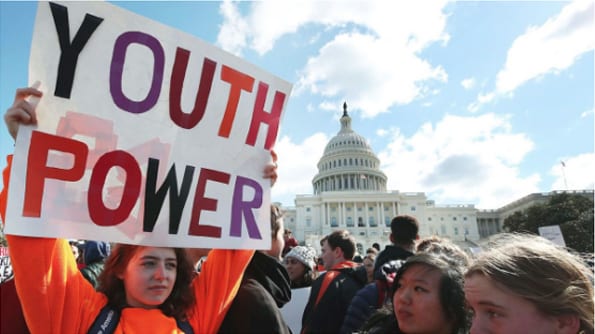
Youth Activism and the #Never Again Movement
The young people are doing what the rest of us should have but haven’t. They are demanding accountability! They have broken through the cloud of pervasive denial. These locked down and mass produced young people have rejected the assumption that they would accept what is being done to them, and that they were too incompetent to object.
Photo+Source: youthrights.org

Teen Activist Tells Davos Elite, You’re To Blame For Climate Crisis
While many delegates at the World Economic Forum arrive in their private jets, 16-year-old Swedisk climate activist Greta Thunberg took a 32-hour train from her home to Davos. She’s also been camping out, trading a luxury hotel stay for a tent in zero degree Fahrenheit.
(Above: CNN, January 25, 2019)
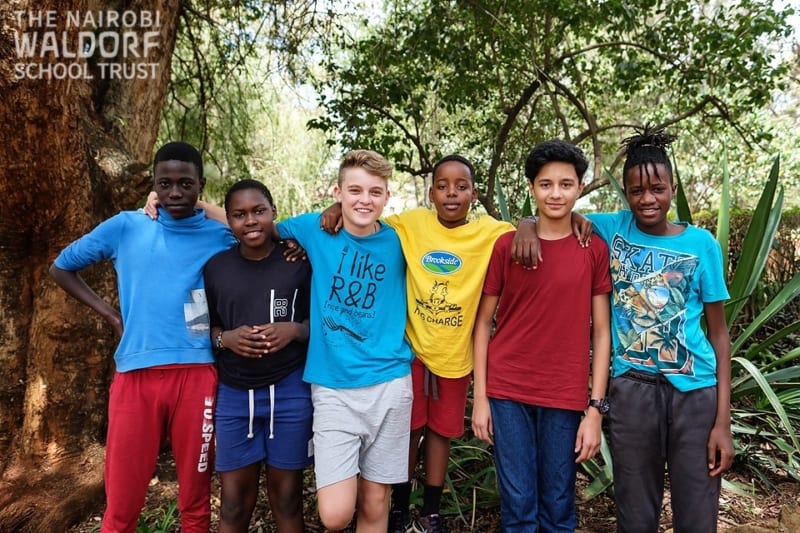

Nairobi Waldorf School 2019 Class 7
After fundraising for, they travelled for a total of 14 hours and provided 5 day un-skilled labour to, building a classroom in Lugari, Kenya.
So, What Defines Gen Z?
A few answers spring to mind, none of them very optimistic: gun violence, environmental threats, the degradation of womens’ rights, an assault on marginalised communities.
And yet, what’s remarkable about Gen Z is that, despite coming of age in politically fraught times, these troubles are not what define them. Instead of being defined by the world around it, Gen Z is comprised of people defining the world –– and its future. Gen Z is known for being idealistic, but it’s not an abstract idealism. They know they need to put in the work. They’ve seen the dangers of apathy, they recognise the perils of a population that participates in its own silencing, and so they speak up.
Gen Z is about movement and action; it is full of self-starters and iconoclasts. It is no coincidence that Gen Z grew up seeing that the motto of the leader of the free world was: HOPE
- They are destined to change the world
- They are digital natives
- They are very independent learners
- The YouTubers are their teachers
- They have a short attention span
- They’re immersed in multitasking
- They have entrepreneurial ambitions
- They’re demanding consumers
- They’re similarly demanding with their future employers
- They’re preparing for professions that we don’t know about yet.
- They’re friends without borders
- They were born, or raised in the midst of an economic crisis
- They prefer images to words
- They’re altruistic
- They have higher IQ than previous generations
(Source: businessinsider, Forbes, huffingtonpost)
Tiffany Zhong dropped out of college to found her own Gen Z research company, Zebra Intelligence
Brands
What Consumers Want
*9% of Americans would switch from a brand without a cause to one that supported a cause, if pricing and quality were comparable
(Source: Forbes)
And 70% of people in the U.S. believe that companies have an obligation to help social causes
(Source: Forbes)

Photo: A recent case is Nike’s decision to feature Colin Kaepernick for the 30th anniversary of the company’s famous “Just Do It” campaign. The campaign caused –– in part –– feverish debates among consumers and marketers, particularly on social media platforms, but seems to overall pay off for the company.
Why Brands Activism wins over Brand Neutrality
In this day and age, consumers are all for authenticity and they’re increasingly putting their money behind brands that are willing to speak up for a cause.
Brands activism, in a nutshell, refers to a situation wherein a company shares their opinion on social, economic, environmental or political issues –– an opinion, which is typically aligned with the company’s defined values. While some companies will simply go on the record and communicate their stance on a controversial issue, others might launch campaigns or initiatives in order to rally people around said issue. It’s undeniable that brands DO get plenty of economic benefit out of brand activism (when done correctly)
Edelman has reported that 57% of 14,000 customers in 14 countries state that they are more likely to buy from, or boycott, a brand because of its stance on social or political issue. (Source: ubermetrics)
In today’s climate of social and political upheaval, it is clear that what is expected of brands and companies is changing. More than ever, people want companies to address some of the most challenging issues of our day. From space travel to ocean plastic, from free speech to public safety, companies are increasingly taking on responsibilities that were formerly the domain of goverment, NPOs and even 501(c)(3) nonprofit organisations.
It can also help a company to recruit and retain talent and employees. Social purpose gives workers a more personal connection to their work, and that often impacts how they do their job.
As a result, corporations are becoming more purpose-driven, which in turn is causing them to seek new ways of engaging with customers, employees and shareholders. People want to do business with, and work for, companies that care, and DuGut™ helps them do that. (Source: Forbes, Cone Communications)
Brands DuGut™
DuGut™ Is Creating New KPIs And Metrics To Measure Social Impact For Brands To Do More Good
DuGut™ was created to encourage brands to give to the causes that consumers care about. Please note, we don’t want to take money away from the causes they already give to, but want them to give to causes that consumers care about and, in fact, increase the amount they give.
Since the 70s, charitable giving has remained at 2% of GDP. Is that some strange economic rule, like unemployment will always be at least 5%? At DuGut™, we just don’t think so!
Then, the question becomes, how do we encourage brands to ‘give more’ and ‘give to the causes consumers care about?’ That is why we build the DuGut™ Marketplace –– to allow us to measure how much good a brand does. DuGut™ is developing new metrics and KPIs that allow us to measure and record all the good a brand does. This can only be accomplished through a new DuGut™ Market platform that allows brands to assess and evaluate the #SocialImpact caused by their brand.
Next, we will look at few different cases and analyse several CSR models and see if we can assess the social good attributable to each of the brands.
Case: Stella Artois, a division of Anheuser-Busch
This is obviously a worthy cause, supplying clean water to places that do not have running water or a regular supply of clean water. StellaArtois will manufacture and sell Limited-Edition Stella Artois Chalice for $10 – $14 each and donate $3.13 per chalice sold to water.org (and this is equal to 5 years of clean water per person). This is clearly an attempt to extract the ‘#socialimpact’ per dollar donated. What is a little confusing is the equivalent clean water metrics from items such as 6 packs and 1 glass of beer.
“Water.org is grateful to Stella Artois for donating $1.2 million USD…” (2018). ($3.13 helps provide 5 years of clean water for 1 person in developing world. Stella Artois will donate $3.13 to water.org for every Limited-Edition Stella Artois Chalice sold in the US between 1/1/19 and 12/13/19, unto 300,000 chalices).
So, what was the #socialimpact of this donation?
It was able to provide just under 1 day of clean drinking water per person ($1.2mil/$3.13 x 5yrs x 365 / 844 million without clean water) –– just a drop in the bucket for those without clean water, but nevertheless a worthy donation and a worthy cause.
Furthermore, does this CSR donation make me feel better about Stella Artois? Perhaps a little.
At DuGut™, we want to make it direct and transparent to determine how much good can be accomplished by a brand. The DuGut™ Market provides the most effective and efficient platform to give to worthy causes. We feel that that is the best way to encourage brands to give more.
Causes
Charities currently get little donation revenue from generation Y & Z, yet they continue to pump resources into activities that simply don’t reach this group. Traditional forms of communication and campaigning –– such as chuggers or charity muggers, newspaper adverts and TV commercials –– simply don’t engage this huge demographic, and charities are missing out in the process.
Nowadays, not-for-profit organisations and charities face the ageing of donors and a growing debate over monetary donation collection methods. They need to find solutions to attract younger generations of donors.
Generation Y appears to be socially conscious yet they evoke more sharing and solidarity than charity. Institutionalised forms of giving particularly via charities and not-for-profit organisations, are rejected. The individuals seem to express their individuality through practices that resemble sharing rather than giving. From a managerial point of view, these results shed light on the factors liable to cause members of this generation to give, such as
- the use of social networks
- Appealing to pleasure, festivities and efficiency rather than to guilt and duty, and,
- Encouragement to ‘work within the not-for-profit organization’
Millennials are highly selective about what organisation they follow in a crowded and noisy media landscape… nearly half of respondents (48.8%) follow one to five organisations on social media. Crucially, this means that, if you want to engage Gen Y, you need to find a way to make sure your signal stands out above the noise –– which means tailoring your content specifically to this group, and focusing your attention on the core issue you’re championing, as opposed to making your brand the key feature.
Of the three factors listed above, the most crucial for increasing this generation’s intention to help a cause is to promote it through an online media platform, such as a social networking site.
With many organisations falling at this first hurdle, it makes perfect sense for more traditional charities to enlist such help from a Gen Y or Z volunteer. Not only will this enable the charity to create more compelling social media campaigns (social networks are a natural stomping ground for Gen Y & Z), but it will also appeal to the intrinsic motivation of the Gen Y & Z volunteer who wants to contribute more than his/her money to a cause he/she believes in.

Source: What does the future hold for giving? An approach using the social representations of Generation Y. International Journal of Nonprofit and Voluntary Sector Marketing. The Effect of Online Media Platforms on Joining Causes: The Impression Management Perspective. Jornal of Broadcasting & Electronic Media